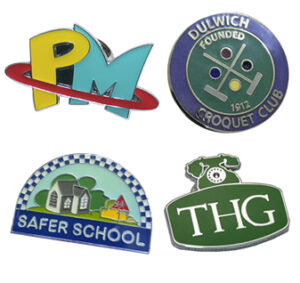
You don’t need to have design experience or professional software to order enamel badges. You can email just a rough sketch, a low-resolution logo, or even just a list of instructions to our designers and they will do all the work for you.
But if you are a professional designer, and you would like to know the rules that our designers are working to, then read on.
1. What shape can an enamel badge be?
Enamel badges can be almost any shape that you can imagine. Every order is completed as a bespoke commission, with the shape of the badge stamped from metal using a custom-made die that is unique to your order. This means there is no inherent difference in price between a square, circle, star, or a wobbly jelly shape!
Where extra cost can occur is if additional tooling is needed to enhance a shape beyond the basic outline created by the die. This happens if you need a cut space within the outline shape, or a particularly acute internal angle which presents an area that is inside of the shape made by the die.
This bespoke shape does not need any inner cuts or extra tooling:

This bespoke shape does need inner cuts (potentially 4 inner cuts, although the spaces could be filled with areas of recessed metal instead to avoid extra tooling):

If the shape that is needed features a lot of inner cuts we may recommend not die-stamping the badge at all, and instead using injection zinc moulding. This reduces cost, because there is no per-cut extra cost, but also offers a stronger result than a die-struck badge which has had a large number of spaces cut away.
For this design we would recommend a zinc alloy badge instead of a die-struck badge:

2. What is the best size for an enamel badge?
The size of the badge is one of the main factors which determines the price. The smaller the badge, the lower that the costs will be. However, a smaller badge size may entail greater design compromises because there will be less scope for fine details or the inclusion of small lettering.
To measure the size, draw an imaginary rectangle around the shape of the badge, then take the longest measurement of height or width.
In this case the height of the imaginary rectangle is the longer measurement, so this badge would be classed as size 32mm. The shorter measurement is not relevant in terms of pricing.

51mm is the usual maximum size for an enamel badge. We can supply them larger, but really above 51mm the badge becomes more of a plaque or a plate than a lapel badge! Because enamel badges are made with a base metal (usually iron or brass) which is then plated and decorated with enamel, the weight of the item becomes a consideration for a size above 51mm. A 60mm by 15mm size might still be comfortable to wear, but a 60mm x 60mm size will likely to be too heavy for use as a normal lapel badge.
There is also no fixed minimum size, but a size less than 10mm will require a fairly simple logo in order to work effectively.
The most popular sizes for enamel badges range from 20mm up to 35mm, but the optimum size is determined by the details of the design itself and also the preference of the client. Should the badge be prominent and obvious on clothing, or should it be a more discrete item for the wearer? The answer depends on the situation and opinion of the client.
3. What colours can I use on my enamel badge?
Modern enamel badges can make use of a choice of thousands of vibrant colours. There is no fixed limit to the number of different colours that can be used on a single badge, but standard prices include up to four different colours. After the first four, subsequent additional colours only add a few pence per badge, although because that is per extra colour the costs can be significant if large numbers of colours are used.
A modern hard enamel badge, featuring bright pantone matched colours of enamel
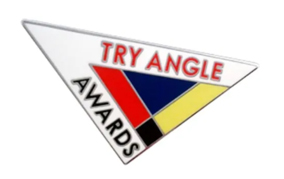
A soft enamel badge, again featuring bright pantone matched colours but this time with an epoxy coating applied:

Colours are pantone colour matched to the solid coated pantone range. Where colour preferences are expressed to us in other values, such as cmyk, rgb, or hex values, our designers will suggest pantone colours.
One of our advisers referring to a pantone swatch book:

Traditional cloisonné enamelling can still be performed. Because the enamel is derived from natural mineral sources the colour range is much more limited. The colours are also naturally duller compared to modern hard or soft enamel badges, although they remain the most authentic option, faithful to traditional handicraft.
A traditional hard enamel badge:

4. Do enamel badges have to use metal outlines and keylines?
Enamel badges feature solid blocks of coloured enamel, each of which are separated by fine lines of metal. This requirement is determined by the manufacturing technique.
When an enamel badge is made, it is first stamped from metal using a die. The initial stamped badge is a map of the design formed only in raised and recessed metal. Coloured enamel is then injected into the different areas of the design.
Therefore, gradients of colour are removed from original drawings, and small details may be enlarged or simplified in order to allow the design to be formed in metal and enamel.
Our designers will do all of this for you, taking an original design and returning a manufacturing proof for your approval. But when you are designing an enamel badge it is worth bearing the requirements in mind.

Where lines of colour are too fine to be outlined in metal and filled with colour, the lines are instead formed in raised metal. This is often the case with small lettering on a badge.

There is no formal specification for the minimum thickness of the metal keylines, or for the minimum size of an area of coloured enamel. But both can be extremely fine, to areas less than a millimetre.
5. Can enamel badges be printed?
If the result of adapting artwork for the enamelling process is not satisfactory for the particular logo or design requirement, printing techniques can be used either instead of enamelling, or to embellish an enamel badge.
The most obvious option is to simply switch to a fully printed metal badge instead. With this badge type the shape is still bespoke, but instead of the design being formed in metal and enamel it is printed, either with spot colours or with a cmyk full colour print process. The advantage of this is that artwork can be replicated exactly as supplied. On the other hand, the badges will perhaps lose some of the weightiness or premium feel of an enamelled badge.
A ‘Printed Metal’ badge (no enamelling involved in the production):

If there are particular details that are problematic, a good compromise can be to use an overprint process on an enamel badge. In this case the enamel badge is produced in the normal way, but an additional print process is then used to overprint a particular detail that was too small to enamel, or contained a gradient that was not possible to enamel.
This enamel badge uses a cmyk overprint to achieve the subtle gradient effect on the red and white globe:

6. What metal plating can I have on an enamel badge?
When used creatively, the metal lines and any areas of raised and recessed metal can act as an additional colour. The metal keylines and details work best when thought of as integral parts of the badge design, rather than an annoying requirement that has to be accommodated.
The badge below sees the silhouettes of the band members and also the smaller lettering formed in nickle silver metal. The badge uses only two enamel colours (black and red) with the details of the design displayed to great effect in simply polished metal.

In the case of the badge below, the logo has been formed in gold metal with a blue enamel background. The effect is probably nicer than if it had been attempted to form the logo in coloured enamel, which would have necessitated metal outlines around all of the logo details.

If you are looking for gold, silver, bronze award badges, we recommend using gold, nickle silver, and copper plating (in real life bronze looks extremely similar to gold, so copper is the best choice!):

Other popular choices for metal plating are antique platings and satin platings. Antique metal platings darken the metal, especially in recessed areas. This is helpful for creating greater contrast between raised and recessed areas than is the case with standard polished metal platings. Meanwhite satin platings create a matt or foggy effect for the metal.

For full information and examples, you can download our metal badge plating guide.
7. How do different levels of raised and recessed metal work on an enamelled badge?
A two-dimensional enamel badge features two flat levels of metal – a recessed level and a raised level. Every area of recessed metal is at the same level, and every area of raised metal is at the same level. There are no slopes or vertical curves between the layers with a two-dimensional enamel badge.
Coloured enamel can be applied into the areas of recessed areas, or they can be left as recessed. If the badge is soft enamel, an epoxy coating can be applied to give a smooth surface to the whole badge.
The badge below features areas of raised metal, recessed metal infilled with colour, and recessed metal that has not been infilled. Also because the badge is soft enamel and has not had an epoxy coating applied, the ridges of raised metal can be felt above the level of the infilled colour. The overall effect is therefore a very tactile three-dimensional item, even though the mould is actually only two-dimensional.

In the badge below the background is recessed gold metal without enamel infill. Other areas have had colour infill. And other details are formed in raised metal. This is a two-dimensional enamel badge, because each level is itself flat. But it has a three dimensional feel because of the way that various areas have been left as plain metal at the recessed level.

If multiple flat levels are not enough for your badge, a three-dimensional mould can be used instead of a two-dimensional mould. With a three-dimensional mould the metal is genuinely moulded in three dimensions, rather than just multiple flat levels.
The badge below uses a 3D mould to achieve a dramatic effect and to be faithful to the original logo:

The badge below uses a three-dimensional mould for the rendering of the dog positioned in the centre of the badge:

8. What else is possible with an enamel badge?
Probably the biggest limitation with enamel badge design is your imagination!
Here are some of the enamel badge commissions that we have completed:
- Glow in the dark enamel badges
- Enamel badges with moving parts
- Glitter enamel badges
- Interlocking enamel badges
- Rainbow enamel badges
- Anodised metal enamel badges
Whatever your idea or requirement, our advisers are ready to help. We offer completely free artwork assistance, and can work from rough drawings or sketches, or a logo supplied with a list of instructions. Contact us for more information.